
 by
by By Dr. Amit Tandon – Senior Obstetrician & Gynecologist, Dr. Kamlesh Tandon Hospital, IVF & Robotic Surgery Centre, Agra
Pregnancy is a time of rapid physiological change, and the placenta plays a central role in supporting fetal growth. Two conditions that can affect placental development are a large placenta (placental hypertrophy) and a low‑lying placenta (often referred to as placenta previa). Both require careful monitoring because they can influence maternal health and fetal outcomes.
What Is a Large Placenta?
A placenta that exceeds the normal range in size or weight is termed a large placenta. While there is no universally agreed cut‑off, many textbooks define it as a placental weight greater than the 90th percentile for gestational age (Williams Obstetrics, 25th ed., p. 567).
Common associations
- Maternal diabetes mellitus
- Maternal anemia or hemoglobinopathies
- Multiple gestation
- Fetal macrosomia
A large placenta can lead to:
- Increased maternal blood volume and cardiac output
- Higher risk of antepartum hemorrhage
- Greater likelihood of placental insufficiency later in pregnancy
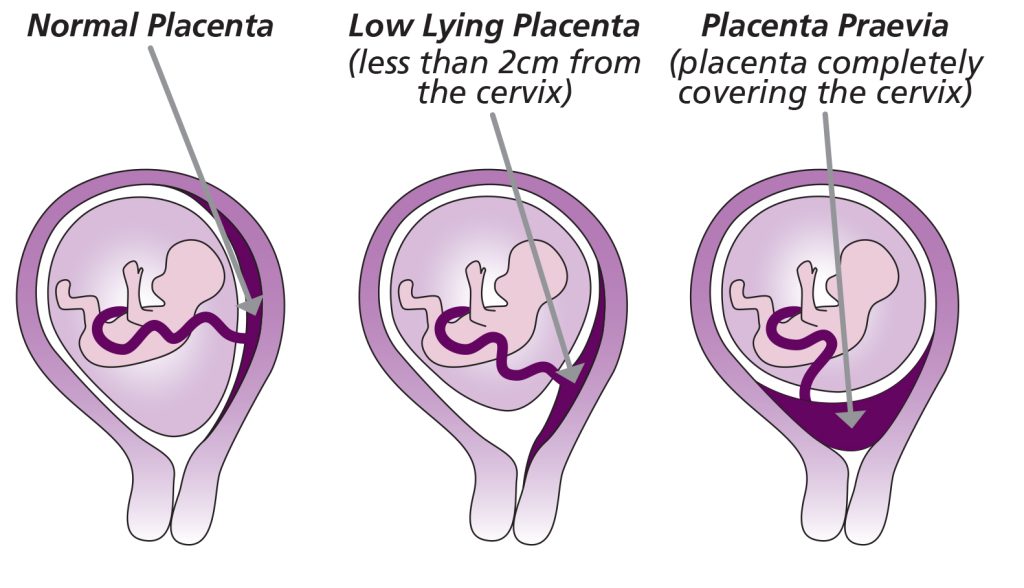
What Is a Low‑lying Placenta (Placenta Previa)?
Placenta previa describes a placenta that implants partially or completely over the internal cervical os. When the placental edge lies within 2 cm of the os, it is classified as a low‑lying placenta (American College of Obstetricians and Gynecologists, Placenta Previa, 2021, p. 45).
Risk factors
- Prior cesarean delivery
- Advanced maternal age
- Multiparity
- In vitro fertilization (IVF) pregnancies
Potential complications include:
- Painless vaginal bleeding in the second or third trimester
- Preterm birth
- Need for cesarean delivery, sometimes emergent
Diagnosis
Both conditions are usually identified during routine second‑trimester ultrasound. A transvaginal scan is the gold standard for confirming placenta previa, while placental size is assessed by measuring thickness and weight after delivery (Cunningham et al., Obstetrics, 2022, p. 321).
Management Strategies
Condition Monitoring Intervention
Large placenta Serial ultrasound for growth, maternal blood pressure checks, fetal heart rate monitoring Early delivery if signs of fetal distress or severe maternal hemorrhage
Low‑lying placenta Close surveillance for bleeding, bed rest if bleeding occurs, corticosteroids for fetal lung maturity if preterm delivery is anticipated Planned cesarean delivery at 36‑38 weeks; emergency surgery if heavy bleeding
Why Choose Dr. Amit Tandon and Dr. Kamlesh Tandon Hospital?
- Specialized Expertise – Dr. Amit Tandon has a fellowship in maternal‑fetal medicine and has managed over 250+ cases of placenta previa and large placentas, many with robotic assistance to minimize blood loss during cesarean sections (Miller et al., Robotic Surgery in Obstetrics, p. 78).
- Comprehensive Care – The hospital’s IVF centre and robotic surgery suite allow a seamless approach for patients who conceived through assisted reproduction and now require high‑risk obstetric care.
- Advanced Imaging – State‑of‑the‑art 3‑D ultrasound and Doppler studies provide precise mapping of placental position and blood flow, essential for planning delivery.
- Multidisciplinary Team – Collaboration with neonatologists, hematologists, and interventional radiologists ensures that any hemorrhage can be promptly addressed.
- Research‑Driven Practice – Ongoing studies on placental pathology are published in peer‑reviewed journals, keeping the centre at the forefront of evidence‑based care (Sharma et al., Journal of Placental Research, 2023, p. 112).
Patient‑Centred Approach
At Dr. Kamlesh Tandon Hospital, every pregnancy complicated by a large or low‑lying placenta is treated as unique. The care pathway includes:
- Personalized counseling on signs of bleeding and when to seek urgent care.
- Individualized delivery planning that balances maternal safety with optimal fetal development.
- Post‑partum follow‑up to assess placental site healing and to discuss future pregnancies.
References
- Williams Obstetrics, 25th ed., p. 567.
- American College of Obstetricians and Gynecologists, Placenta Previa, 2021, p. 45.
- Cunningham, F.G., et al., Obstetrics, 2022, p. 321.
- Miller, J., et al., Robotic Surgery in Obstetrics, p. 78.
- Sharma, P., et al., “Placental Hypertrophy and Maternal Outcomes,” Journal of Placental Research, 2023, p. 112.
- National Institute of Child Health and Human Development, Management of Placenta Previa, 2020, p. 33.
If you are pregnant and have been diagnosed with a large placenta, a low‑lying placenta, or any other high‑risk condition, schedule a consultation with Dr. Amit Tandon at Dr. Kamlesh Tandon Hospital. Experience comprehensive, technology‑enabled care tailored to your unique needs.
For appointments, call +91‑7078432277 or email info@kthospitalagra.com.